
Plug vs. Patch: Which Tire Repair Actually Holds?
A rope plug and a patch-plug combo aren't the same repair. The safety and reliability difference, what tire-industry and NHTSA guidance actually says, and when neither one is safe.
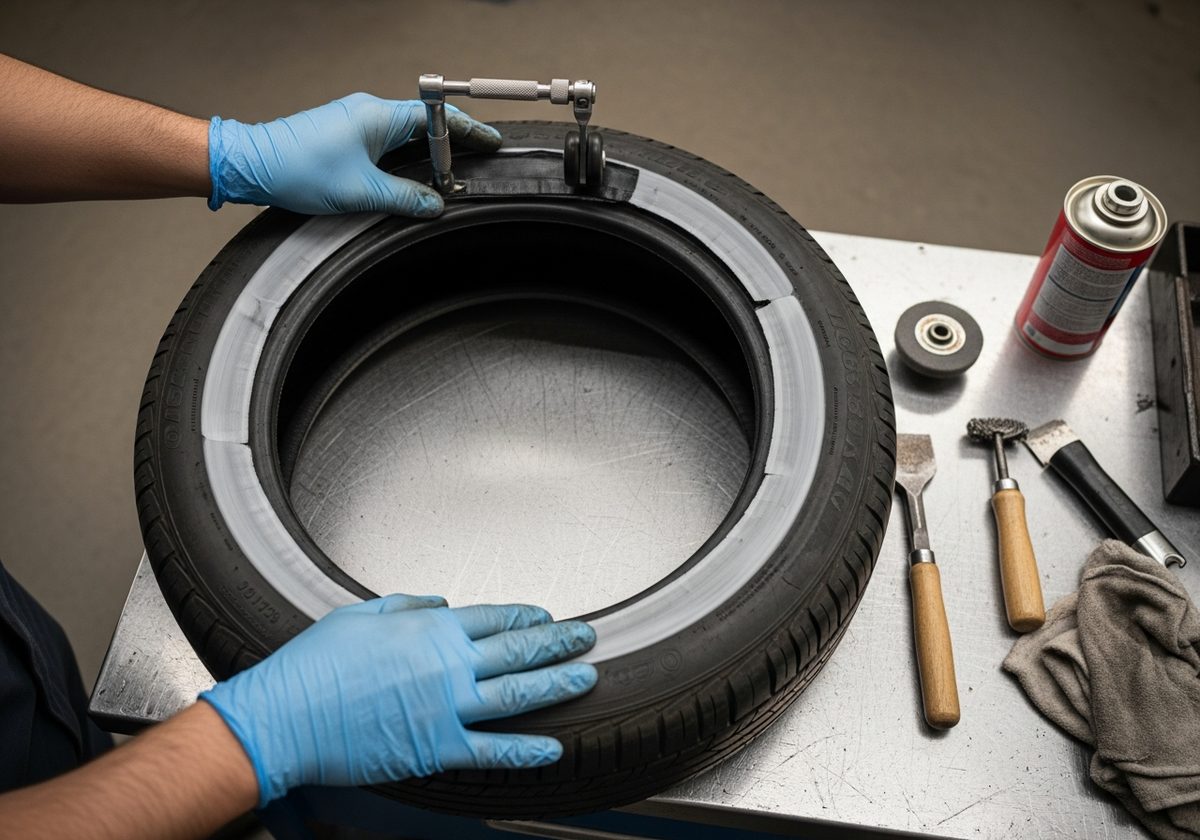
A rope plug and a patch-plug combo repair are not the same fix, even though both get called 'plugging a tire' in everyday conversation. A plug-only repair pushes a sticky rubber cord into the puncture from outside the tire, without ever taking the tire off the rim. A patch-plug combo dismounts the tire, inspects the inside for hidden damage, and seals the puncture from the inner liner outward with a patch bonded to a plug filling the hole. Tire-industry repair standards recognize only the second method as a permanent repair. The first is a roadside stopgap. Here's the actual safety and reliability difference, and when neither one is the right call.
What a plug-only repair actually is
A plug-only repair, the kind you get from a gas-station kit or a mobile tire tech working out of a van, uses a reaming tool to rough up the puncture channel, then pushes a sticky rubber-and-fabric cord into the hole from the outside. It seals fast, doesn't require any special equipment, and gets you moving again in a few minutes. The tradeoff is that it never touches the inside of the tire — the technician never sees the inner liner, never confirms the puncture didn't damage the steel belts, and never checks for a second hidden puncture nearby. It's a repair made blind, and it stays that way for as long as the plug is in the tire.
What a patch-plug combo repair actually is
A proper repair starts by dismounting the tire fully off the wheel, which is the only way to inspect the inner liner. From there, the technician measures the puncture, checks the surrounding cord for damage, and installs a combination unit: a plug that fills the puncture channel and a patch that bonds over the inner liner around it, vulcanized or chemically bonded into a single airtight seal. It's slower, it requires the tire to come off the rim, and it costs a little more in labor. It's also the only method that lets anyone actually see what's going on inside the tire before calling it safe to drive on again.
Why the inner liner matters so much
Air pressure inside a tire pushes outward against the inner liner, not the tread. A patch bonded to that inner liner gets pressed tighter against the tire the more pressure builds — the physics work in the repair's favor. A plug stuffed in from the outside works against that pressure instead of with it: the same air pressure that's supposed to keep the tire round is also the force slowly trying to push the plug back out over time, heat cycles, and flexing. That's the core reason a plug-only fix tends to hold fine for a while and then fail without warning, often as a slow leak that shows up weeks or months later rather than an immediate blowout.
What NHTSA and tire-industry guidance actually says
NHTSA's consumer tire safety guidance and the repair standards published by the U.S. Tire Manufacturers Association and the Tire Industry Association both point the same direction: a proper puncture repair requires dismounting the tire, inspecting the inner liner, and applying a combination patch-plug from the inside. Neither body endorses a plug-only repair as a permanent fix — it's treated as a temporary measure at best, something to get you to a shop rather than something to drive on indefinitely. That's the standard we follow on every repair; we don't offer plug-only as an option even though it would be faster and cheaper to sell.
The safety case against plug-only
Beyond the physics, there's a practical inspection problem. A hard enough impact to puncture a tire can also damage the steel belts or cords around the hole without breaking through to the surface — damage you can only see from the inside, with the tire off the rim. A plug-only repair skips that inspection entirely, so a tire that looks fine from the outside can still be carrying hidden structural damage that a proper dismount-and-inspect repair would have caught. That's the scenario behind most of the 'my tire was fine and then it just blew out' stories — often it wasn't fine, nobody just looked.
DIY plug kits: what they get right and wrong
The plug kits sold at auto parts stores work exactly as designed for what they're built for: a fast, temporary seal you can install yourself on the shoulder of the road. Where they fall short isn't the plug material, it's everything the kit can't do — it can't dismount the tire, can't show you the inner liner, and can't tell you whether the puncture is actually in a repairable location versus the sidewall. Using one to get home safely is smart. Treating the result as a finished repair and forgetting about it is the mistake we see most often.
When a plug is still the right call
None of this means a plug is useless. If you're stranded and a plug kit is what gets you off the shoulder of I-376 and to a shop safely, use it — a temporary repair that gets you somewhere beats sitting on the roadside. The key word is temporary. Treat a plug as a bridge to a real repair, not the repair itself, and get the tire properly dismounted and inspected within a day or two, not months later.
Signs a previous repair was a plug, not a patch
If you didn't do the repair yourself, there are a few ways to tell what's already in your tire. A plug looks like a small rubber or fabric stem sticking slightly proud of the tread surface from the outside, sometimes trimmed close but still visible as a slightly different texture than the surrounding rubber. A proper patch-plug combo is invisible from the outside entirely — all the repair material is bonded to the inner liner, so there's nothing to see unless the tire is off the rim. If you can see a repair from outside the tire, it's a plug, and it's worth having it inspected and redone properly.
How long does each repair actually last?
A properly installed patch-plug combo is considered a permanent repair by tire-industry standards — it should last for the remaining useful life of the tire, the same as the surrounding tread. A plug-only repair doesn't carry that same expectation; it can hold for months or fail within days, and there's no reliable way to predict which, because nobody inspected what's happening on the inside. That unpredictability, more than the plug's raw material strength, is the real argument for treating it as temporary rather than trusting it long-term.
Run-flat and larger tires: does the method change?
Run-flat tires have reinforced sidewalls specifically designed to support the vehicle briefly after a puncture, and most manufacturers recommend against repairing them at all after they've been driven in run-flat mode, regardless of patch or plug — the internal structure has likely already been compromised by the unsupported driving. Larger truck and SUV tires can generally be patched and plugged the same way as a passenger tire, just with more surface area to inspect and slightly more labor time.
When neither patch nor plug is safe
Some damage isn't repairable by either method, and it's worth knowing the difference so nobody talks you into a fix that shouldn't happen. Sidewall punctures, shoulder-area damage, punctures larger than about 1/4 inch, and tires that were driven on while flat all fall outside safe-repair territory regardless of which method you're offered. Our tire repairability guide walks through the full decision framework — sidewall versus tread, the driven-on-flat rule, and where the size cutoff sits — if you want to know before you bring it in.
Cost difference between the two
A gas-station plug kit runs you the cost of the kit, maybe $10-15, plus your own time and risk. A proper patch-plug combo at our shop runs $20 to $50 including a TPMS reset, and takes 30 to 45 minutes. Our flat tire repair cost guide has the full pricing breakdown, including what happens when the tire turns out not to be repairable at all.
What to ask before you agree to a repair
Two questions cut through most of the confusion: did the tire come off the rim, and did someone actually look at the inside? If the answer to both is yes, you're getting a real repair. If either answer is no, or nobody can tell you, you're getting a plug — which might be fine as a temporary measure, but shouldn't be sold to you as the final fix.
What we do
Every puncture repair we do is a full dismount, inner-liner inspection, and combination patch-plug — no plug-only shortcuts, no exceptions, regardless of how simple the puncture looks from outside. If a previous plug is already in your tire and it's holding, we'll still recommend pulling it and doing the repair properly rather than leaving a known temporary fix in place. Call (724) 679-7829 or stop by 400 Railroad Street, Bldg 1 Garage 4 — open 7 AM to 9 PM, seven days a week.
FAQ
- Is a tire plug safe long-term?
- Not by tire-industry standards. A plug-only repair, installed from the outside without dismounting the tire, is treated as a temporary fix. For a permanent repair, the tire needs to come off the rim so the inner liner can be inspected and a combination patch-plug installed from the inside.
- What's the difference between a plug and a patch?
- A plug is inserted from outside the tire without removing it from the wheel. A patch is bonded to the inner liner after the tire is dismounted and inspected. A patch-plug combo does both at once and is the only method tire-industry standards recognize as a permanent repair.
- Can I just get a plug instead of a patch to save money?
- We don't offer plug-only repairs, because the small cost difference isn't worth trading away a proper internal inspection and a permanent seal. Every repair we do is a full dismount and patch-plug combo, priced the same regardless of how simple the puncture looks.
- Do gas station plug kits work?
- For a temporary, get-you-home fix, yes — they're a reasonable emergency tool. They're not a substitute for a proper repair, since they can't dismount the tire or inspect the inner liner for hidden damage. Treat a DIY plug as a bridge to a real repair within a day or two.
- How do I know if my tire was repaired with a plug or a patch?
- A plug is visible from outside the tire as a small rubber or fabric stem in the tread. A proper patch-plug combo is invisible from the outside — all the repair material is on the inner liner, so you'd only see it with the tire off the rim.
- Is a plugged tire safe at highway speed?
- A properly installed patch-plug combo is safe at any speed the tire is normally rated for. A plug-only repair carries more uncertainty, since nobody inspected the inside of the tire, which is why it's treated as temporary rather than something to rely on for regular highway driving.
- Does NHTSA recommend tire plugs?
- NHTSA's consumer tire safety guidance, along with U.S. Tire Manufacturers Association and Tire Industry Association repair standards, points to the combination patch-plug installed after dismounting the tire as the proper repair method — not a plug-only fix from the outside, which is considered a temporary measure at best.
Bring it to us. We'll tell you straight.
Photo-first quotes. Real prices. Open 7 days, 7am–9pm.